5/14/2009

Demolitions - Cold Springs

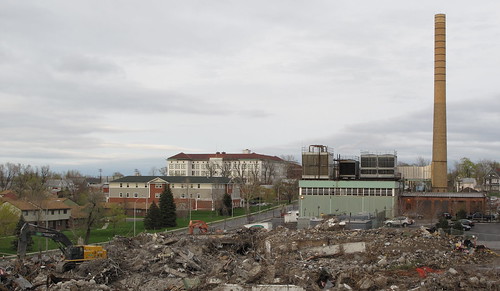
A number of houses in Masten's Cold Springs neighborhood have been demolished in recent days. After languishing for more than a year, this burnout at 235 Woodlawn was sent to the landfill earlier this week.
IMG_2932 IMG_5738
235 Woodlawn - before/after
click to enlarge

I wrote about 235 Woodlawn a few months ago - There is No Plan, Part II. The recent pattern of demolition activity suggests that there may be a strategy. The four houses that were demolished this week were some of the neighborhood's worst - probably no chance for rehab - and were located in close proximity to Performing Arts High School and School #8 on East Utica, the temporary home of City Honors High School.
Another truck with wrecker on board just turned the corner and pulled up down the street, right across from Performing Arts. Strategic and targeted demolitions are a welcome relief.
__________________________________________________________________________
Artspace • BAVPA • Woodlawn Row Houses • fixBuffalo flickr
Creative Class • Shrinking Cities • Saturdays in the Neighborhood

5/13/2009

(re)Imagine the City - Built to Last

I received a number of emails today from fixBuffalo readers informing me of the following award winning short video. Check out the official word from the Congress for the New Urbanism.

The outstanding 3-minute video asks the question “What’s the greatest threat to our planet?” and shows how reimagining our cities and suburbs to be sustainable and walkable will cut carbon emissions, commutes and calories. "When it comes to saving the planet, what we build is the greatest threat…or the greatest hope," say the filmmakers in Built to Last.

“Built to Last made me laugh out loud,” said John Norquist, president and CEO of the Congress for the New Urbanism, which offered the submitter of the winning entry a complimentary registration to this year's leading gathering of urbanists,CNU 17, which runs June 10-14th in Denver. “But this video is serious too. First + Main and Paget Films show how New Urbanism is the convenient remedy, providing quality of life and economic value while protecting the environment.”

fixBuffalo readers may remember John Paget's video about the Queen City Farm project, right here. Connect with John Paget at Paget Films.
__________________________________________________________________________
Artspace • BAVPA • Woodlawn Row Houses • fixBuffalo flickr
Creative Class • Shrinking Cities • Saturdays in the Neighborhood

5/12/2009

Farm Report - Breaking Ground!

This afternoon Buffalo's Common Council voted to approve what's considered a 'pilot project' and an agreement between the City and Mark and Janice Stevens. 27 vacant lots on Wilson Street - between Broadway and Sycamore - will become the largest 'urban farm' on this part of the planet.
IMG_4447
Wilson Street - Farm Block
The Stevens bought a house last year on Fillmore Avenue. Their backyard opens on Wilson Street across the street from what is sure to become a transformative project for neighborhood and city residents.

Amy Kedron, the founder and Executive Director of Buffalo First had this to say upon hearing the results of today's Common Council decision.
Now Buffalo can join the ranks of the nation's most desirable cities that are distinguishing themselves by establishing highly sought after urban farms. More importantly this will strengthen our local food system.
Mark told me that he was excited to begin work on 60 raised beds for this years growing season. If you're interested in dropping the Stevens a line or interested in knowing how you can land a hand, you can reach Mark and Janice here - woodmasstev@gmail.com.

I'll be following this story as it develops in the weeks and months ahead.
__________________________________________________________________________
Artspace • BAVPA • Woodlawn Row Houses • fixBuffalo flickr
Creative Class • Shrinking Cities • Saturdays in the Neighborhood

5/11/2009

City Honors - May 2009 Update


I walked around the City Honors construction site the other day and noticed that the natatorium is being enclosed. The foundation for the new all high gymnasium is beginning to take shape, too. A number of the BMHA residences surrounding City Honors are scheduled for demolition as part of the comprehensive site plan as seen here.
IMG_5726
Work on the $40m reconstruction of City Honors is scheduled to be complete for the beginning of the 2010 school year.
IMG_5727
Check out the City Honors archive for additional information and pics.
__________________________________________________________________________
Artspace • BAVPA • Woodlawn Row Houses • fixBuffalo flickr
Creative Class • Shrinking Cities • Saturdays in the neighborhood

Woodlawn Row Houses - May 2009 Update

IMG_5731
The Woodlawn Row Houses are still owned by the City of Buffalo and represent an amazing opportunity for the right individual. They're are located steps away from the recently renovated Buffalo Academy for the Visual and Performing Arts High School and a few short blocks from the Utica Station.

After years of getting close to reaching a deal with various development teams, my March 2009 update outlined what I think may be the best development scenario for this project.

If you're interested in taking a closer look at these, let me know.
__________________________________________________________________________
Artspace • BAVPA • Woodlawn Row Houses • fixBuffalo flickr
Creative Class • Shrinking Cities • Saturdays in the Neighborhood

5/05/2009

The Other Housing Crisis

Michael Clarke, Executive Director of LISC-Buffalo, just sent along the following - Empty Neighborhoods Fill the Rustbelt - the latest AP story about the other housing crisis, the forgotten one. It's the crisis that remains after cities lose half their population and shrink before houses are eventually trucked off to landfills. The article appeared today in newspapers all over the country.
Meet the forgotten housing crisis. While most attention has focused on the wave of foreclosures sweeping mostly middle-class, suburban Sunbelt neighborhoods from California to Florida, the nation's emptiest neighborhoods have remained concentrated in the same place for nearly a generation: the mostly minority, poor, urban neighborhoods of the American Rust Belt.
Buffalo's story weaves its way through the article in a number of prominent parts.

"I'd move in a heartbeat if I had somewhere to go right now," said Cindy Olejniczak of Buffalo, raking trash from the lawn of a boarded-up house to keep it from blowing in her yard. Roughly every third home in her neighborhood is vacant. Not even pizzerias will deliver to the area now.

"It's almost like you wish they would just level the whole neighborhood," she said, "and start rebuilding again from scratch."

Buffalo News reporter Brian Meyer picked up the story this afternoon - Buffalo Has 6 of 10 Most Deserted Neighborhoods in the State.

IMG_4673

more Buffalo 'urban prairie' pics

The AP analysis relies on US Postal Service and HUD data about emerging vacancy patterns. In Buffalo, LISC-Buffalo has been at the vanguard of analyis and public policy development around vacancy issues and urban land use development. Last year I posted this - Undeliverable & Unbelievable - Unstoppable? - that borrows heavily on LISC's distillation of this mountain of data in the US Postal Service/HUD mash-up.

Michael Clarke shared the following with me this afternoon:
Anthony (Armstrong LISC-Buffalo Program Officer) advises that the AP only counted "vacant" not the "no stat" category, which means they vastly under-report the problem in chronically stressed tracts. Tract 27.02 reported at 30% vacant, but with no stats it would have been 37.6%, the worst of them, tract 28 has a combined "vacant" and "no stat" of 39.1%, but this only showed up as 27.6% in the AP tables.
Today's short AP video - Empty Neighborhoods - shouldn't be missed.
__________________________________________________________________________
Artspace • BAVPA • Woodlawn Row Houses • fixBuffalo flickr
Creative Class • Shrinking Cities • Saturdays in the Neighborhood

5/04/2009

Down the Road in Rochester...

The image “http://media.redclaycms.com/sites/135/images/2009%20conf%20header.gif” cannot be displayed, because it contains errors.
This conference maybe of some interest to fixBuffalo readers.

Association for Community Design: 2009 Annual Conference
June 4 to June 7
Rochester, New York

In the wake of spiraling economic challenges, the ideology of community design should play a key role in an infusion of renewed hope and possibility for civic engagement, innovative planning and community building. We encourage everyone with a commitment to community design to join together this spring to share ideas and strategize about how we can function effectively and provide leadership for thoughtful and inclusive design of our built environment.

Please save the dates June 4th through June 7th for the Association for Community Design's 2009 Conference when we will gather in Rochester, New York to focus on the role of community design through a series of discussions, workshops, site visits and tours that will help engage, focus and inspire our thoughts and actions.

More details here.
__________________________________________________________________________
Artspace • BAVPA • Woodlawn Row Houses • fixBuffalo flickr
Creative Class • Shrinking Cities • Saturdays in the Neighborhood

5/01/2009

Freddie's Demo

The anticipated demolition of the former Freddie's Donut site on Main Street near Michigan Avenue began this morning.
IMG_5256
See - Freddies's Going, Going... for additional information, links and a number of nostalgic comments about the sweetest spot on Main Street.
__________________________________________________________________________
Artspace • BAVPA • Woodlawn Row Houses • fixBuffalo flickr
Creative Class • Shrinking Cities • Saturdays in the Neighborhood

Byron's Poor Plan

I struggled through Mayor Brown's poor plan last night. Buffalo News columnist Donn Esmonde's redux appeared this morning - Brown Brings a Peashooter to Poverty War.
The 77-page “Buffalo Poverty Reduction Blueprint” is so devoid of ideas, so lacking in imagination, that its totality of initiatives can be summed up in a sentence: Create a task force.

Perhaps never in history has one document assembled such a quantity of eyeball- glazing, business-as-usual bureaucratic catchphrases: Promote small business. Strengthen the family. Encourage youth development. Improve school readiness.

It is as if whoever wrote this thing got paid by the platitude.

We do not need a position paper. We need a plan of attack.

In the bigger picture, a document such as this begs the question of why this man wants to be mayor.

If this is the best Brown can do, on so huge of an issue, he should step aside for someone who has some ideas. It is as if the house is on fire, and the guy in charge shows up with a bucket of water.

There is no plan.

__________________________________________________________________________
Artspace • BAVPA • Woodlawn Row Houses • fixBuffalo flickr
Creative Class • Shrinking Cities • Saturdays in the Neighborhood

4/29/2009

Buffalo's Urban Farms - 1893

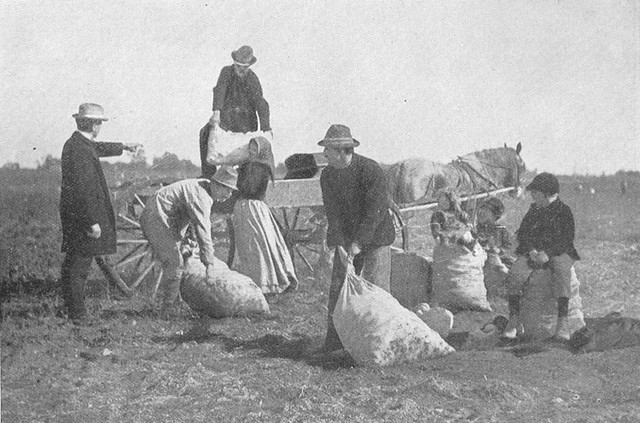
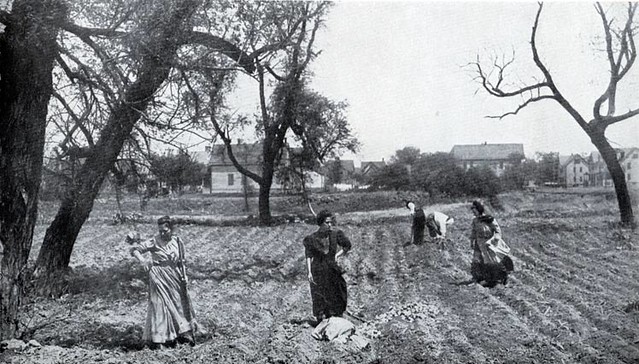
While searching the WNY Heritage Press site recently for old Buffalo pics, I found this short article chronicling a new city initiative when Buffalo was poor and jobs were scarce - urban farming! Here's the link - The Depression of 1893-1897 Buffalo's Urban Farms.

potato_harvesting_1896
photo from WNY Heritage Press
In 1895, Mayor Edgar Boardman Jewett, newly elected mayor of Buffalo, proposed that Buffalo follow the example Detroit which had utilized vacant land in the city for use by poor people as farms. The city would solicit the loan of such land from landowners, prepare the fields by having them plowed, and provide the seeds.
1911_city_fields
photo from WNY Heritage Press

During the depression in 1893 Mayor Pingree of Detroit was nationally known for his reformist policies.
Pingree expanded the public welfare programs, initiated public works for the unemployed, built new schools, parks, and public baths. He gained national recognition through his "potato patch plan," a systematic use of vacant city land for gardens which would produce food for the city's poor.
Today Detroit is the country's poorest city. In Michigan, elected officials on a state and local level now embrace what was widely successful over a hundred years ago - see, Farm Report - From Detroit. The issues swirling around poverty and food security in Buffalo - the country's third poorest city - are just as severe and the human impact is just as acute. Buffalo followed Detroit's public policy success in 1893. Why not in 2009?

See - Wilson Street Urban Farm
__________________________________________________________________________
Artspace • BAVPA • Woodlawn Row Houses • fixBuffalo flickr
Creative Class • Shrinking Cities • Saturdays in the Neighborhood

Demo Progress on Goodrich Continues

I went to the top of one my favorite parking ramps yesterday (corner of Goodrich and Ellicott) and grabbed this shot looking east towards Michigan Avenue.
IMG_5185
The demolition is still taking place here along Goodrich Street in preparation for the Kaleida/UB project I posted about a few weeks ago - Medical Campus Meets Midtown.

Investment in the immediate neighborhood is accelerating. In the pic, City Honors is center left, where a $40m renovation is underway. The new brick and two tone vinyl building nearby fronts on Michigan Avenue. I first posted pics about it three years ago, here.

I'll be adding additional pics to my Kaleida/UB flickr series as this project develops.

See the following posts for additional background information - Kaleida Expands, Again and the Hamlin House Demoltion also on Goodrich Street, from October 2006.

See - Kaleida Archive for additional information.
__________________________________________________________________________
Artspace • BAVPA • Woodlawn Row Houses • fixBuffalo flickr
Creative Class • Shrinking Cities • Saturdays in the Neighborhood
4/24/2009

Saturdays in the Neighborhood
The weekly Artspace Neighborhood walk is tomorrow at 10am and lasts an hour.  Here the details and a flickr series of recent Saturday morning pics.
__________________________________________________________________________
Artspace • BAVPA • Woodlawn Row Houses • fixBuffalo flickr
Creative Class • Shrinking Cities • Saturdays in the neighborhood

4/23/2009

Farm Report - from Buffalo

Kirk Laubenstein told me earlier this afternoon that the Grassroots Garden board has approved the application that Mark and Janice Stevens submitted last week for their urban farm project on Wilson Street. fixBuffalo readers will recall last week's post about the city's newest urban farming initiative - Wilson Street Urban Farm.
IMG_4454
Future home of Wilson Street Urban Farm
The next step is Common Council approval and a signed lease agreement with the Dept. of Economic Development. Approval for the signed lease agreement has been reportedly signaled by Commissioner Brian Reilly.
__________________________________________________________________________
Artspace • BAVPA • Woodlawn Row Houses • fixBuffalo flickr
Creative Class • Shrinking Cities • Saturdays in the neighborhood

Farm Report - from Detroit


I noticed this from Model D today - Detroit Development News
State land bank going green, offering vacant lots up as community gardens

The State of Michigan Land Bank Fast Track Authority is making its inventory of nearly 7,000 vacant lots statewide -- 6,000 in Detroit alone -- available as community gardens via its Garden for Growth program.

"Our goals, in addition to finding productive uses for these vacant plots, is to support the Governor's Urban Food Initiative," says Carrie Lewand-Monroe, the Michigan Land Bank's executive director. "We're hoping to help allow folks in urban areas to access fresh, healthy food."

The way it works is that any community member can apply to garden a lot in the Michigan Land Bank for $50 for one year. At that point, participants are able to put in an application to purchase the land.

This lease-first approach is considered a "best practice" for programs of this type for two reasons: It allows time for the garden to be established and it keeps it tax-free for the first year. The Land Bank is willing to flexible with lease terms; it is working with The Greening of Detroit on five parcels that will be leased for five years.

Any kind of garden is eligible: native plants, flowers and vegetables -- even a park, says Lewand-Monroe. All gardeners will be connected with the Greening of Detroit's Garden Resource Program for classes and planting material.

Lewand-Monroe explains why 7,000 of the Michigan Land Bank's 8,000 properties are vacant lots: because they are all foreclosed properties that date back to 1999, which was when tax laws changed. "There aren't as many structures as the county would have," she says.

They also administer a Side Lot program for vacant lots that are adjacent to occupied residences. To search for a property, use the Land Bank's web site Search for Property feature. The application for the Garden for Growth program is also available on the site.
__________________________________________________________________________
Artspace • BAVPA • Woodlawn Row Houses • fixBuffalo flickr
Creative Class • Shrinking Cities • Saturdays in the neighborhood

4/22/2009

A Land Bank for Buffalo? - See Today's NYT!

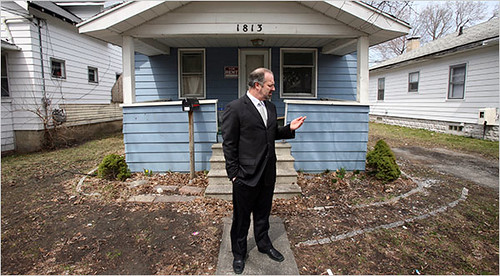
An Effort to Save Flint Michigan by Shrinking It appears in today's New York Times. The article highlights the work of Dan Kildee and the Genesee County Land Bank - the go-to resource for best practices in managing urban decline.
22flint_600
Dan Kildee in front of his childhood home, Flint Michigan. NYT photo.
Dozens of proposals have been floated over the years to slow this city’s endless decline. Now another idea is gaining support: speed it up. Instead of waiting for houses to become abandoned and then pulling them down, local leaders are talking about demolishing entire blocks and even whole neighborhoods.

The population would be condensed into a few viable areas. So would stores and services. A city built to manufacture cars would be returned in large measure to the forest primeval.

“Decline in Flint is like gravity, a fact of life,” said Dan Kildee, the Genesee County treasurer and chief spokesman for the movement to shrink Flint. “We need to control it instead of letting it control us.”
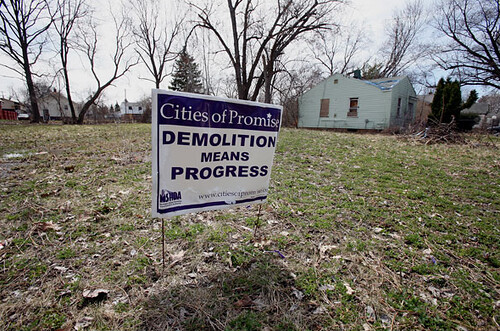
pic lifted from a New York Times article that I've posted about here
from today's NYT article & slide show - Cities of Promise
The Buffalo News had a related series of articles last year about Buffalo's housing crisis. See Living on the Edge where I floated the idea that city services in certain sections of Broadway/Fillmore should be shut down.

See also - Our Urban Prairie, Summer 2008 and Getting Smarter about Decline.
__________________________________________________________________________
Artspace • BAVPA • Woodlawn Row Houses • fixBuffalo flickr
Creative Class • Shrinking Cities • Saturdays in the neighborhood