
This is not good!
Read what other Wall Street Journal readers are saying about Kelo, over here.
Susette Kelo said this...
I was in this battle to save my home and, in the process, protect the rights of working class homeowners throughout the country. I am very disappointed that the Court sided with powerful government and business interests.Craig, over at America's North Coast, is the only other Buffalo Blogger picking up on this story. This Land is my Land is Craig's intro into this development.
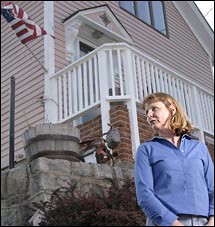
Susette Kelo

Susette Kelo was represented by attorneys from the Institute for Justice. They made this statement shortly after the 5-4 Supreme Court decision was issued. Lots of good case back ground there, too.
Check it out for all sorts of good comments.
And, don't miss what the Property Rights Foundation of America has to say
about Kelo v. City of New London. Yikes!
The dispute, known as Susette Kelo v. City of New London, centers around a single principle-whether the government can condemn property to transfer it to another private party for the claimed “public purpose” of economic development. During recent years, government agencies far and wide have been condemning urban properties using the excuse that the properties are “blighted,” whether or not this is reasonably the case, but with the Fort Trumbull neighborhood, the city is exercising its eminent domain power solely on the basis of economic development. Therefore, the question that the homeowners are presenting to the U. S. Supreme Court is narrowly defined to that of whether, or to what degree, economic development is a constitutional reason for eminent domain.
Answers anyone?
Oh...and here's some more of the dissent written by Justice Clarence Thomas...
The Court has elsewhere recognized “the overriding respect for the sanctity of the home that has been embedded in our traditions since the origins of the Republic,” Payton, supra, at 601, when the issue is only whether the government may search a home. Yet today the Court tells us that we are not to “second-guess the City’s considered judgments,” ante, at 18, when the issue is, instead, whether the government may take the infinitely more intrusive step of tearing down petitioners’ homes. Something has gone seriously awry with this Court’s interpretation of the Constitution. ** Though citizens are safe from the government in their homes, the homes themselves are not.** ----------------And Wikipedia is all over Kelo v. City of New London.
From Page 53 of the KELO v. CITY OF NEW LONDON
Following the decision, many of the plaintiffs expressed an intent to find other means by which they could continue contesting the seizure of their homes. However, the Supreme Court having disposed of the eminent domain issue, the only legal avenue left to Kelo and her fellow residents may be to contest the fairness of the amount that the city intends to pay for the land - the city has reportedly set aside $1.6 million to buy all 15 homes, and city officials believe that they will be in possession of the property within a few months.
Obviously, the wider effect of Kelo remains to be seen. It will have little effect in the eight states that specifically prohibit the use of eminent domain for economic development except to eliminate blight: Arkansas, Florida, Illinois, Kentucky, Maine, Montana, South Carolina and Washington. Most legal experts do not see a rush by cities to take advantage of the decision.
Artspace Archive • Annals of Neglect • BAVPA • Where is Perrysburg? • Broken Promises...
Writing the City • Woodlawn Row Houses • Tour dé Neglect - 2006 • faq


3 comments:
Wait a second. How do I get to be a Buffalo Blogger? Because I'm in Buffalo, I am a Blogger and I complained about this on the 23rd.
But, honestly, you did a much better job of that. Great post!
Like Carlton...what's the name of your blog..go ahead...give it up!
Oh, hey! It's:
http://gradstudentmadness.blogspot.com
I guess it could be called a pseudo-Buffalo blog because I'm in Canada half the week. Maybe a quasi-Buffalo Blog.
Post a Comment