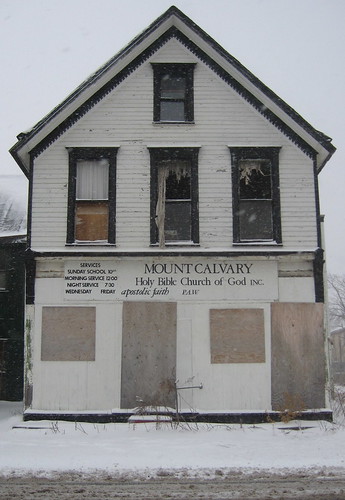
While I have no professional training in urban planning, design or public policy - I see what I see. The patterns that slowly emerge have a way of changing the language I use to describe what's happening in my neighborhood. What I sense sort of soaks into my consciousness and changes the way I see and how I respond to others.
First started using the language - shrinking city - when I started thinking harder about issues of abandonment and vacancy in my own neighborhood and slowly warmed up to a study sponsored in part by LISC - Buffalo, see October 2005 post -
23,000 and Still Counting. Almost a year later and after many meet-ups with Michael Clarke, Ex. Director of LISC - Buffalo, I was invited to attend the unveiling of a report
Blue Print Buffalo a few months ago. See -
Getting Smarter about Decline.One of the on-line sources used is shaping
Blue Print Buffalo is the work of a bunch of europeans dealing with similar issues -
Shrinking Cities (Love the German term -
schrumpfen Städte, sort of smurf like). The work is opening in Detroit tomorrow evening - road trip anyone? - at the Museum of Contemporary Art Detroit -
here's the link.Shrinking Cities, a project by Germany's Federal Cultural Foundation, the Kulturstiftung des Bundes, explores a form of urban development that has become a global phenomenon. Starting in 2002, local teams were commissioned in Detroit (USA), Manchester/Liverpool (Britain), Ivanovo (Russia), and Halle/Leipzig (Germany) to investigate and document processes of urban shrinking. In more than fifty exhibition contributions, artists, architects, filmmakers, journalists, culture experts, and sociologists reveal and illuminate the changing realities of these cities.
Vacancy junkies - guess I'm one, remember being able to identify Detroit's vacant structures during the
Blue Print Buffalo unveiling - understand Detroit is pretty much the poster child in North America for
schrumpfen. Wrote about a film documenting this-
Detroit Ruin of a City. See especially,
Ruins of Modernity - links to professional conferences and additional information about the film. Just found this youtube video - a ten minute short -
Tour of Detroit's Ghetto.Back in 2004 when I started opening my eyes to the systemic abandonment and vacancy in my own neighborhood, I linked to an observation by a French Sociologist,
Loïc Wacquant as he observed what's happening at the other end of Lake Erie, in Detroit.
Why are you building new structures, spending millions of dollars building new sports structures and entertainment centers, when you have the historic heritage of the city's right here abandoned across the street. To a European it's totally incomprehensible. Wacquant is nearly speechless as he gazes at vacant houses with sagging porches and trails of stained brick leading from the walls to the weed-choked lawns.
Wrote recently about Vergara's spin on this phenomenon in his
The New American Ghetto. Here, Vergara weaves together various dystopian themes commonly associated with movies such as
Metropolis (1927),
Blade Runner (1981) and
Brazil (1985) - which I've yet to see.
So what's this post about...had conversations today with two well published and very gifted observers of abandonment and vacancy issues here in Buffalo. They both agreed, reason why places like
1325 Michigan and
97 Dodge are sliding down hill fast has nothing to with race. It's a class issue. I mean who wants to really see and experience the subsidization of poverty? From a distance sure. But not next door.
Anyways, if I don't go to Detroit this weekend, I'll be getting my hands on a copy of
Brazil.